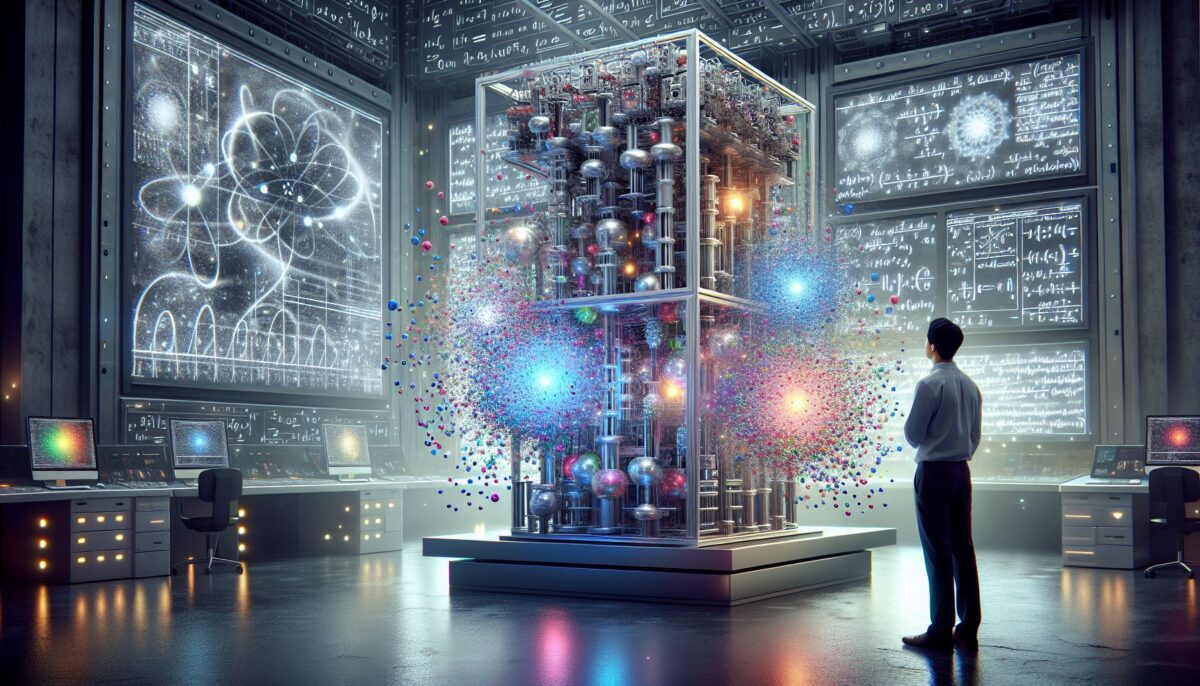
Hey, fellow tech enthusiasts! Gather ’round and let’s have a little chat about what might just be the wildest frontier in technology today: quantum computing. I know what you’re thinking: Isn’t quantum stuff reserved for particle physicists who like to scribble mysterious equations on blackboards? Well, not anymore! Quantum computing is breaking out of the lab and is about to completely change how we think about computing power. Let’s dive into this beautifully bizarre world and see what makes it tick.
Quantum Basics: Schrodinger’s Cat and All That
First off, let’s tackle the basics. Classical computers, like the trusty laptop you’re using, compute using binary bits—those iconic ones and zeros. Quantum computers, however, use qubits, which can be both one and zero at the same time, thanks to a phenomenon called superposition. Imagine if you could be both asleep and awake while catching up on your favorite Netflix series. Mind-boggling, right?
And there’s more! Qubits are not shy; they get friendly through a concept known as entanglement. This interconnection means the state of one qubit can depend on the state of another, even if they’re miles apart. It’s Einstein’s “spooky action at a distance” working its magic in the computing realm.
Current Developments: From Theory to Practice
The cool thing is, we’re seeing real companies get all quantum-y. Take IBM, Google, and D-Wave as examples. These guys aren’t just theorizing; they’ve built quantum prototypes that, although still in early stages, show real promise. Google, in fact, made headlines with a demonstration of “quantum supremacy,” where their quantum machine performed a task in seconds that would’ve taken a classical supercomputer an eternity.
Yet, I must confess, quantum computers today are still as temperamental as a cat on a Monday. They struggle with error rates and maintaining stable qubits, known as coherence. It’s like trying to catch lightning bugs in a jar—just when you think you’ve got them, they flicker out. But that’s exactly what makes this field so exhilarating; it’s the Wild West of computing!
The Quantum Leap: Implications for the Future
Now, what does all this mean for us average tech folk? Well, hold onto your hats, because quantum computing could shake up several fields like a tech-induced earthquake.
In cryptography, for instance, quantum computers could crack codes that would take classical computers eons to solve, potentially making current encryption methods as outdated as dial-up internet. Though, no need to panic just yet—quantum-safe algorithms are already being developed.
And remember those sci-fi dreams of AI that can learn at supercharged speeds? Quantum computing could turbocharge machine learning models, breaking the current barriers of calculations and simulations. This means breakthroughs in everything from drug discovery to finance. Picture AI algorithms that can predict market shifts before they happen or develop vaccines in record times.
Challenges Ahead: Not All Smooth Sailing
But hey, let’s not hire cheerleaders and get the confetti out just yet. Quantum computing is no easy feat. It comes with its own Pandora’s box of challenges—like temperature sensitivities and the sheer difficulty of scaling up. Those qubits prefer ultra-cool environments, close to absolute zero. While I love a good chill, that’s a bit too chilly even for me!
We need to invent new error-correction techniques and build scalable models for these wunderkinds of computing. We’re pushing the boundaries of what’s technologically possible, and innovation is the only metric that matters here. Yet, isn’t that the kind of challenge we all secretly adore?
Looking Ahead: The Quantum Dream
So, what can we expect next? If I had a crystal ball—ideally in the form of a qubit—I’d say we’re likely to see quantum computing tackling real-world problems within the next decade. Picture a future where processing powers are limited only by our imaginations.
For budding tech startups, this is a goldmine waiting to be explored. Think beyond our current tech limitations—new software paradigms and use cases will emerge, as rough and experimental as the first apps on smartphones once were. Quantum computing could spark the kind of revolution we last saw with the dawn of the internet. The possibilities? They’re endless.
Conclusion: Embracing the Quantum Weirdness
As we stand on this precipice of a quantum dawn, I encourage you all to keep an eye on this space. Follow the roller coaster ride of developments, get involved if you can, and welcome the weirdness that quantum computing promises.
It’s a brave new world out there, and isn’t it just buzzing with the thrill of what might emerge from the quantum cosmos? It’s unconventional and bewildering, sure, but that’s precisely what makes this whole thing so exciting.
So, here’s to the explorers, the dreamers, and a future so wild, we’ll need quantum shades. Cheers!
